Caminando por Bangkok

Los ultimos 3 anos, he vivido, descubierto, probado y explorado lo que es vivir en esta fantastica ciudad. Ahora es tiempo de compartir mis historias.

Friday, 15 August 2014

Riding through the past - Atravesando el pasado

About 700 years ago, in northern Thailand, existed the Kingdom of Sukhothai, the first capital of the Siam Empire.  This is a place I have wanted to go for a long time, and this weekend, finally I did.  This time, our legs took us out of Bangkok, and we went 400kms north, but not walking. There are quite a few ways to get there and Elaine and I decided to fly. 

Hace unos 700 anos, en el norte de Tailandia exisitio el Reino de Sukhothai, la primera capital del Imperio de Siam.  Este es un lugar al que quise ir desde que vine a Tailandia y este ultimo fin de semana, finalmente fui.  Esta vez, fuimos 400km al norte de Bangkok, obviamente no caminando, hay varias formas de llegar a Sukhothai y esta vez Elaine y yo decidimos volar.


Lotus Village
So we headed to Don Mueang airport and took an early AirAsia, one hour flight to Phitsanulok, from where a shuttle bus took us - in under an hour to Sukhothai. Probably the best decision we made, was to stay at Lotus Village.  Lotus Village is an extremely peaceful, wooden, Thai style, full of flowers, ponds and plants guesthouse, with extremely helpful staff and in a very convenient location.

Tomamos un vuelo mananero de una hora, con AirAsia, desde el aeropuerto de Don Mueang hasta Phitsanulok y de ahi conectamos con una van y en menos de una hora estabamos en Sukhothai. Problabemente la mejor decision que tomamos fue hospedarnos en el Lotus Village.  Un sitio muy tranquilo, construido en madera al estilo Thai antiguo, lleno de flores, estanques y plantas, con un staff excelente y en una ubicacion super adecuada.


Local bus ride to the historic park
After checking in and deciding what to do for the day, we were off.  The easiest way to get to the Historic Park is to walk down to Charot Withinthing Rd, heading west cross the bridge and 50mts after the 7/11 - on the left hand side - you will find a local bus stop, from where for 30 bahts and after 20 minutes, buses will drop you right in the heart of the park. Here you have two options - well three, but motorbikes were not an option for today - you can either walk, or rent a bicycle. The park has 5 sections: central, north, east, west and south, and we wanted to do it all. The central, northern and west sections cost 100 bahts per person, plus 10, 30 or 50 bahts for parking, per bicycle, motorcycle or car.  

Despues de registrarnos y decidir nuestro plan del dia, salimos.  La manera mas facil de llegar al Parque Hsitorico de Sukhothai es, caminar hacia el oeste por la calle Charot Withinthing, cruzar el puente y 50mt despues del 7/11 (a mano izquierda) llegamos al paradero de buses locales, que por 30 bahts y en 20 minutos te dejan en la entrada del parque.  Aqui tienes dos opciones - bueno tres, pero alquilar una moto hoy no estaba en los planes - puedes caminar o alquilar una bicicleta. El parque tiene 5 secciones; la central, norte, este, oeste y sur, y queriamos hacerlas todas. La central, norte y oeste cobran 100 bahts por persona y 10, 30 o 50 bahts mas por estacionamiento de bici, moto o carro. 


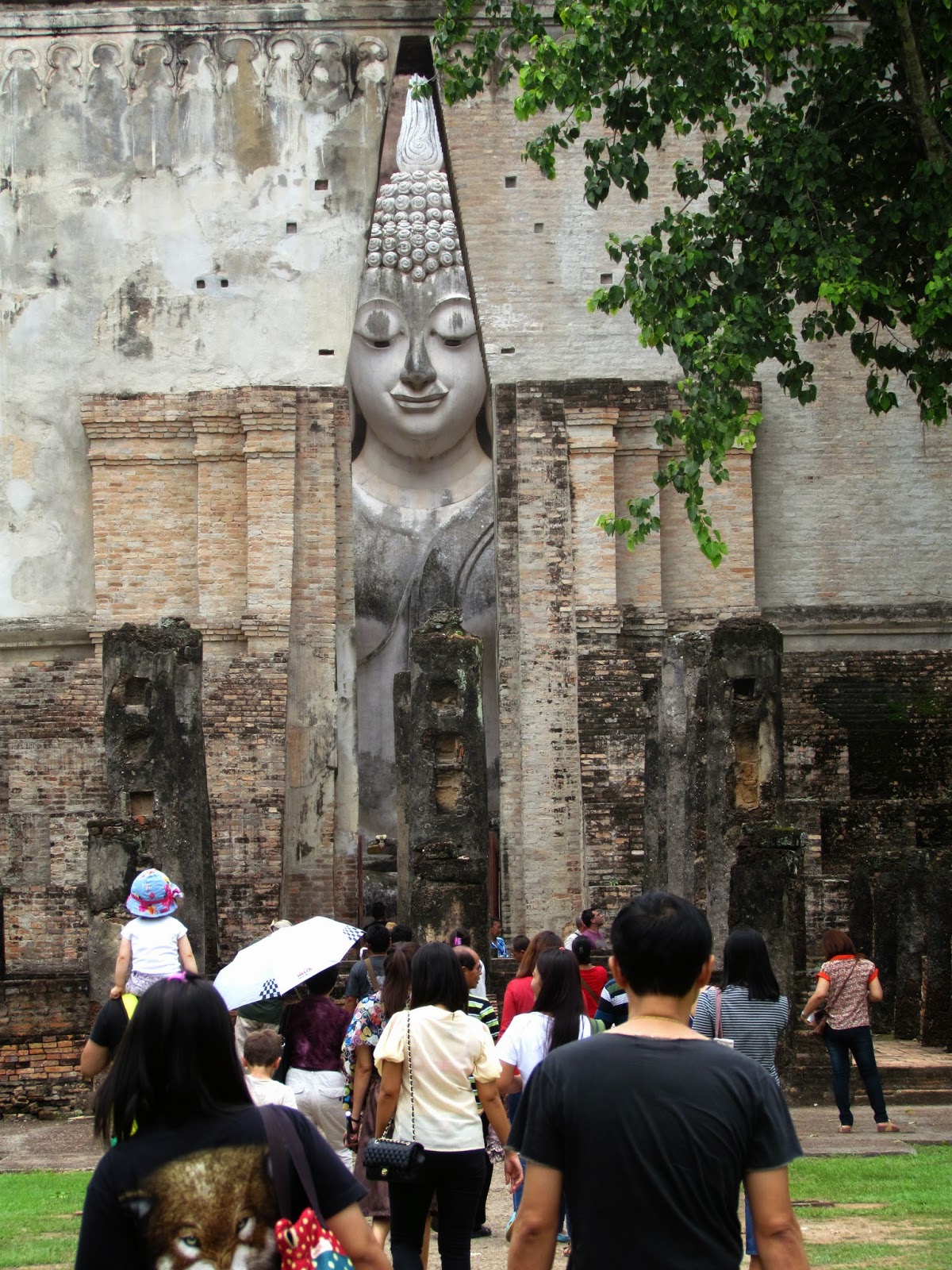
Buddha statue at Wat Mahathat
Surrounded by a 7.2km wall the central area is where we would start, with the main temples, ruins and palaces located here.  So, we decided to rent push bikes to cover more land and for 30 bahts a day per person this is a great option.  Once on our bikes we headed towards our first stop, Wat Mahathat. This amazing enclosure and its almost 200 chedis make it a very impressive sight.  It is said that this temple contains a hair and piece of neck bone of the Buddha himself, collected by King Lo Thai in Sri Lanka in the 14th century. Another incredible detail of this temple are the two 12mtr standing Buddha statues on both sides of the main chedi.

Rodeada por un muro de 7.2km el area central es donde queriamos empezar, ya que aqui estan los principales templos, palacios y ruinas.  Decidimos alquilar dos bicicletas para cubrir mas terreno y por 30 bahts cada una, esta es sin duda la mejor opcion.  Ya en nuestras bicis, fuimos hacia la primera parada, Wat Mahathat.  Este sorprendente recinto y sus casi 200 chedis son una vista impresionante.  Se dice que en este templo se encuentran un cabello y un pedazo del hueso del cuello del mismo Buda, recogidos por el rey Lo Thai en Sri Lanka en el siglo 14.  Otro impresionante detalle del templo, son las dos estatuas de 12mt de Buda - de pie - a cada lado del chedi principal.


We were completely absorbed and overwhelmed by the energy and peace of the ruins and were enjoying every single second since the start.  So without wasting any time, we headed towards Wat Si Sawai.  The most interesting thing about this temple is how much it looks like the temples of Angkor, Cambodia - both - architecturally and aesthetically.  It shows very clearly the strong influence that the Khmer Empire had in all the region for more than 5 centuries. 

Ya estabamos completamente absorbidos y sobrecogidos por la energia y la paz del sitio y estabamos disfrutando cada segundo, asi que in desperdiciar un minuto, continuamos hacia Wat Si Sawai.  Lo mas interesante de este templo es cuanto se parece a los templos de Angkor en Camboya, en cuanto a su arquitectura y estetica. Si Sawai, muestra claramente la fuerte influencia que el Imperio Khmer tuvo en la region por mas de cinco siglos.


Khmer influence at Wat Si Sawai


Image of walking Buddha
After Si Sawai and riding through some minor temples and ruins we arrived to Wat Thapangngern. There is not much to see here but a statue of Buddha and an unusual image of a walking Buddha to one of its sides.  The highlight of this temple is that it is surrounded by the Silver Lake and to get to it you have to cross a small bridge, which creates quite an awesome scenery.


 Chedi by the Silver Lake
Dejamos Si Sawai y atravesamos algunos templos y ruinas menores en camino a Wat Tahapangngern.  Aqui no hay mucho que ver ademas de una estatua de Buda y una muy inusual imagen de Buda caminando a uno de los lados, pero lo mas destacado del templo es que esta en una isla, rodeado por el Lago de Plata y para llegar a el hay que cruzar un pequeno puente y todo junto crea un panorama espectacular.

Closer to the northern wall there are two minor temples that are worth checking out; Wat Sorasak and Wat Song Khao.  Although they are a bit away from the main central area temples, it is this isolation which makes them a great and peaceful stop to have a snack and recharge your batteries. Wat Sorasak's most amazing feature are the 24 elephant heads supporting a stupa.


Cerca al muro norte hay dos templos menores, que bien valen la pena visitar; Wat Sorasak y Wat Song Khao.  Ambos estan un poco alejados de los templos principales, pero es este aislamiento lo que los hace una gran y pacifica parada, donde a la sombra de un enorme arbol puedes recargar baterias y descansar del fuerte sol.  Lo mas impresionante son las 24 cabezas de elefante de Wat Sorasak, soportando todo el peso de una gran estupa.


24 elephant heads supporting the stupa of Wat Sorasak


Khmer influence in Wat Phra Phai Luang
As we were on the northern area of the site, we took the Sang Luang gate and headed to Wat Phra Phai Luang. This is a temple of great significance, because its edifices, constructed through different periods, are proof of the evolution of the Sukhothai style.  Again, here you can see a Khmer influence which is proof of the strong relation between these two powerful empires.  A little bit to the west is Wat Si Chum and the outstanding 11.3mts statue of Buddha that it houses, which occupies the total space of the building containing it.  Something else very important about Wat Si Chum is that here the Wat Si Chum Inscription Stone was found, which tells the story of the foundation of Sukhothai.


Ya que estabamos cerca al area norte del sitio, tomamos la puerta Sang Luang y fuimos hacia Wat Phra Phai Luang.  Un templo de enorme importancia debido a que sus edificios, construidos durante diferentes periodos son muestra de la evolucion de estilo Sukhothai. Ademas, aqui tambien se ve la influencia Khmer, otra muestra de la fuerte relacion entre estos dos poderosos imperios.  Un poco mas al oeste esta Wat Si Chum y en su interior, la excepcional estatua de 11.3mt de Buda que ocupa todo el espacio del recinto en el que se encuentra.  Fue aqui donde ese encontro la piedra tallada de Wat Si Chum, cuyos grabados narran la historia de la fundacion de Sukhothai.


Buddha image at Wat Si Chum


Stone bridge at Wat Saphan Hin
There are quite a few other temples in the northern area, but they are all in ruins and therefore we decided just to ride through them while heading west, to the mountain temples.  The west area of the park, holds Wat Saphan Hin. A temple on a mountain top with an amazing view of Sukhothai's Old City and one of the most beautiful statues of Buddha, called Phra Attharot Buddha.  To reach the top of the mountain there is a 300mts path known as the "Stone Bridge". In a stone found in the temple, it says that King Ramkamhaeng would ride his white elephant to the top on full moon nights to present his respects to Buddha. 


Buddha image at Wat Saphan Hin

Los demas templos de la zona norte, se encuentran en ruinas y por eso decidimos simplemente atravezar el area dirigiendonos hacia la zona oeste y los templos de las montanas.  Aqui en la cima de una montana esta el templo de Wat Saphan Hin.  Este templo tiene una increible vista de la ciudad antigua de Sukhothai y una de las estatuas mas bonitas de Buda llamada, Phra Attharot Buddha. Para llegar a la cima, hay q seguir un camino conocido como el Puente de Piedras.  En una piedra hallada en este templo hay un grabado que cuenta que el rey Ramkamhaeng, subia al templo en su elefante blanco en noches de luna llena, para presentarle sus respetos a Buda. 


By now, it was well after noon and we needed to go get some food.  Close to our starting point we saw there were a few restaurants, serving some local delicious dishes.  It took us quite a bit of time to go through the run down chedis of the west and through the central area all the way to the east side of the site, but by the time we got there, our appetite was just right for us to sit down, relax and enjoy.  We had some delicious Gai Yang (grilled chicken), Som Tam Khai Kem (papaya salad with hard boiled egg) and Khao Niew (sticky rice), we repeated every single dish and downed it all with quite a few Leo beers.  Delicious. 


Ya habiamos pasado la hora de almuerzo y necesitabamos ir por algo de comer. Cerca a nuestro punto de partida, vimos algunos restaurantes donde servian platos locales y hacia alla nos dirigimos. Nos tomo un poco de tiempo, pero en el camino atravezamos templos, bosques, puentes, chedis en ruinas y la parte sur de la zona central, asi que cuando llegamos estabamos con el apetito adecuado para sentarnos, disfrutar y relajarnos.  Nos pedimos unos deliciosos Gai Yang (trozos de pollo dulce a la parrilla), Som Tam Khai Kem (ensalada de papaya con huevo duro salado) y Khao Niew (arroz glutinoso), repetimos cada plato y los bajamos con varias cervezas Leo. Para que mas?


Lotus flowers at Thra Phang Tra Kuan pond
The sun was starting to set and we still had one more temple we wanted to see, Wat Sa Si, maybe one of the most attractive monuments in the park. It is on a small island, surrounded by hundreds of lotus flowers in the Thra Phang Tra Kuan pond. It is not a big temple, but its beautiful main chedi in Singhalese style and the Buddha statue in the "calling the earth to witness" position make of it an incredible sight.  Besides - and to our surprise - in this temple, starting at 730pm there was going to be a performance telling the tale of the foundation of Sukhothai, together with a lights show and some fireworks.  So surrounded by a couple hundred of Thai and farang visitors, we sat down and enjoyed the show. Although it was impossible to understand, as all the narration is in Thai, the lightning and fireworks were quite impressive. 

El sol ya se empezaba a poner y aun habia un templo mas que queriamos ver, Wat Sa Si. Uno de los monumentos mas atractivos del parque.  Esta en una pequena isla en el centro del estanque Thra Phang Tra Kuan, rodeado de cientos de hermosas flores de loto.  No es un templo grande, pero su chedi principal, en estilo Singales y la estatua de Buda en posicion de "llamando a la tierra a ser testigo" lo hacen una vista en verdad espectacular.  Ademas - y para nuestra sorpresa - a las 730pm iba a haber un show, contando la historia de la fundacion de Sukhothai con show de luces y fuegos artificiales.  En este momento, ya estabamos rodeados de cientos de Thais y algunos pocos extranjeros, asi q nos sentamos a disfrutar del show.  Para nuestra mala suerte no entendimos nada ya que toda la narracion del show es en tailandes, pero las luces y los fuegos artificiales fueron impresionantes.  


Buddha image and chedi at Wat Sa Si

By the time the show ended and we handed back our bikes to the rental shop, it was almost 830pm and our only way to do the 12kms back to New Sukhothai town was by a 200 bahts tuk tuk ride.  As it started to rain on us we jumped on to our tuk-tuk and headed back, and this also gave us time to get back home, have a beer and think about our visit for tomorrow, to the Historical Park of Si Sat Chanalai, 60kms north, but that will be tomorrow.


Cuando el show tremino y devolvimos nuestras bicicletas ya eran casi las 830pm y la unica forma de regresar al Nuevo Sukhothai era en un tuk-tuk por 200 bahts.  Justo en ese momento empezo a llover fuerte, como siempre en Tailandia, asi que tomamos nuestro tuk-tuk y regresamos en menos de 15 minutos y esto nos dio mas tiempo para sentarnos a tomar una cerveza y pensar en nuestra visita de manana al parque historico de Sisat Chanalai. Pero eso sera manana.


Some information about the transportation used, historical park and places visited.

Lotus Village
Sukhothai Historical Park
Nokair


Wednesday, 23 July 2014

Walking around Chinatown & Little India - Caminando por el barrio chino y la pequena India

For thousands of years the Chinese have been exploring, settling, influencing and have become an active part of Asia's commerce and business life.  And their presence in Singapore, Malaysia, Laos, Vietnam and Thailand can be seen everywhere.  In many cities of the world nowadays we can find a Chinatown area, and probably one of the most real - which keeps alive it's traditions and celebrations - is the Chinatown in Bangkok.  For the last 100 years (since October 15, 1915) Chinatown has been growing together with Bangkok. 


Durante miles de anos, la cultura china ha explorado, colonizado, influenciado y se ha convertido en un lider de la vida comercial de Asia.  Y su presencia en Laos, Singapur, Malasia, Vietnam y Tailandia se puede ver en cualquier lugar. Es mas, en muchas ciudades del mundo podemos encontrar un barrio chino y tal vez, uno de los mas reales, donde se mantienen vivas las tradiciones y costumbres, es el barrio chino en Bangkok. Desde el 15 de octubre de 1915, hace casi 100 anos, el barrio chino ha crecido junto con Bangkok.


Visiting Chinatown is definitely a mind blowing experience.  There is people everywhere!  Coming in and out of alleys which you might never notice, which end in hidden temples, flooded by incense smoke, or more alleys.  The strong smell from food stalls cooking typical delicacies is everywhere. Hundreds of motorcycles coming from every direction and delivery trolleys carrying the most unexpected goods between shops. Chinatown can make any day an incredible day.

Visitar el barrio chino es una experiencia unica.  Hay gente por todos lados, entrando y saliendo de callejones que ni te habias dado cuenta que estaban ahi, que terminan en templos escondidos, inundados por el humo de los inciensos, o en otros callejones.  El fuerte olor de los puestos donde se cocinan las delicias tipicas lo abarca todo.  Cientos de motocicletas fluyen en todas las direcciones posibles, igual que los cargadores, llevando los mas inesperados productos entre tiendas. En este barrio cualquier dia, puede ser un dia increible.


Wat Rajaburana
So, after deciding how we were going to submerge ourselves in this neighborhood, we made our way to the Memorial Bridge pier.  If you get to Chao Phraya river, no matter where, at any pier, just jump into one of the Orange Flag taxi boats and for 15 bahts you will get there. Easy!  Right next to the pier you will find the Memorial Park and right in front of it you will see Wat Rajaburana, also known as Wat Liab.  (For some weird reason i still don't understand, everything in Thailand seems to have two or three names).  The wat was built in the 15th century under the reign of King Sam Phraya and during the late 1700's it was the seat of the Head Monk Patriarch of the Thai Sangha (Buddhist Assmebly).  The temple deserves a visit, as it holds over 80 statues that were evacuated from Ayuthaya when the Burmese invaded the city in 1767. 

Entonces, despues de decidir como ibamos a sumergirnos en este barrio, fuimos en bote hasta el muelle del Memorial Bridge.  Desde cualquier muelle en el Chao Phraya te puedes tomar un bote de bandera naranja y por 15 bahts llegas. Facil.  Justo al lado del muelle esta el Parque Memorial y al frente se puede ver el Wat Rajaburana, tambien llamado Wat Liab. (Por alguna razon, que hasta ahora no entiendo, todo en Tailandia tiene dos o tres nombres). Fue construido en el siglo 15 bajo el reinado de Sam Phraya y en la segunda mitad de los 1700 fue el trono del Monje Patriarca del Thai Sangha (la Asamblea Budista). El templo merece una visita ya que contiene unas 80 estatuas que fueron evacuadas desde Ayuthaya cuando los burmeses invadieron la ciudad en 1767.


Continuing up into Chinatown itself, we decided to make a short detour and walked up north by Triphet Rd. into the Indian area, also known as Little India.
Not a very big area, but as it turned out, a very big surprise. First of all, people change.  Sikhs and Muslims now flow out from every corner and the language, the background music, the smells, the food, is different. After exploring the fantastic Pahurat Cloth Market, we found a small samosas stand on an alley on Chakraphet Rd. and next to an impressive Sikh Temple, Sri Guru Singh Sabha. The samosas and tikki (deep fried dumplings stuffed with potatoes) that Raspal Singh offers are outstanding.  For 8 bahts per bite you can delight in a delicious Indian combo, served with a delicious sweet sour sauce that will make you lick your fingers.

Continuando hacia el barrio chino, decidimos hacer un pequeno desvio por la calle Triphet hacia el barrio indio, conocido como la Pequena India. No es un area muy grande, pero si una gran sorpresa.  Primero porque la gente cambia. Sikhs y musulmanes salen de todas las esquinas y el lenguaje, la musica, los olores, la comida, todo, es diferente.  Despues de recorrer el mercado Pahurat encontramos un puesto de samosas (como unas empanadas) en un callejon, sobre la avenida Chakraphet y junto al Sri Guru Singh Sabha, un impresionante templo Sikh.  Las samosas y el tikki (frituras rellenas de papa) de Raspal Singha resultaron increibles, por solo 8 bahts (menos de un sol) por pieza puedes disfrutar un delicioso combo indio, servido con una deliciosa salsa agri dulce que va a hacer que te chupes los dedos.


Tikki, samosas & sweet sour sauce.


"Pet" crocodile
So, belly full after our snack, we headed towards something we really wanted to see. Next to Wat Chakkrawat, in a labyrinth of alleys, there is a small monk's residential area, where in a pond the monks keep, we had read, a very unusual pet.  A giant crocodile.  We were not only surprised to find this was true, but also by the size of this "pet".  He - or she - was almost the size of the pond! maybe 5mts long? When we wondered what they would be feeding this big fellow with, we realized...we hadn't seen any dogs or cats for a while.  Unfortunately there weren't any monks around to ask.

Con la barriga llena nos dirigimos hacia un destino que teniamos muchas ganas de ver.  Al lado de Wat Chakkrawat, en un laberinto de callejones hay un complejo residencial de monjes, donde en un pequeno estanque, los monjes tienen una inusual mascota.  Un cocodrilo gigante. Nuestra sorpresa no solo fue ver que esto era verdad, sino al ver el tamano de esta mascota.  El - o la - cocodrilo media unos 5mts.  Cuando nos pusimos a pensar en como alimentarian a tremendo animal, nos dimos cuenta, que en un buen rato, no habiamos visto perros ni gatos.  Para nuestra mala suerte no habia ningun monje a quien preguntarle.

  
Therefore we just kept on going finally into the heart of Chinatown.  So we took Sampeng Lane, once Chinatown's main road and now a mega street market lane. Here you can find anything you want and a lot that you don't want. Shops specialize in what they sell; plastic shoes, hair bobbles, belts, dried shrimp, pet stores (no crocodiles though), zippers, watches, coin purses, t-shirts, underwear, velcro, sweets, boxes, restaurants, plastic bags, pens, etc, etc, etc. No wonder that the Chinese community is a major part of the business in the city.  These lane alone, goes for more than 20 blocks full of stands, shops and walking sellers.  

Asi q decidimos seguir hacia el corazon del barrio chino.  Subimos por el pasaje Sampeng, una vez la calle principal del barrio convertida en un mega-mercado callejero, donde se puede encontrar absolutamente de todo.  Aqui las tiendas en verdad se especializan en lo que venden; zapatos de plastico, ligas para el pelo, correas, charqui de langostino, tiendas de mascotas (sin cocodrilos), zierres, relojes, monederos, polos, ropa interior, pega-pega, dulces, cajas, restaurantes, bolsas, lapiceros, etc, etc, etc.  No queda ninguna duda de porque la comunidad china es la tajada mas grande del mercado de la ciudad.  Solo este pasaje, tiene mas de 20 cuadras llenas de tiendas, puestos y vendedores ambulantes.


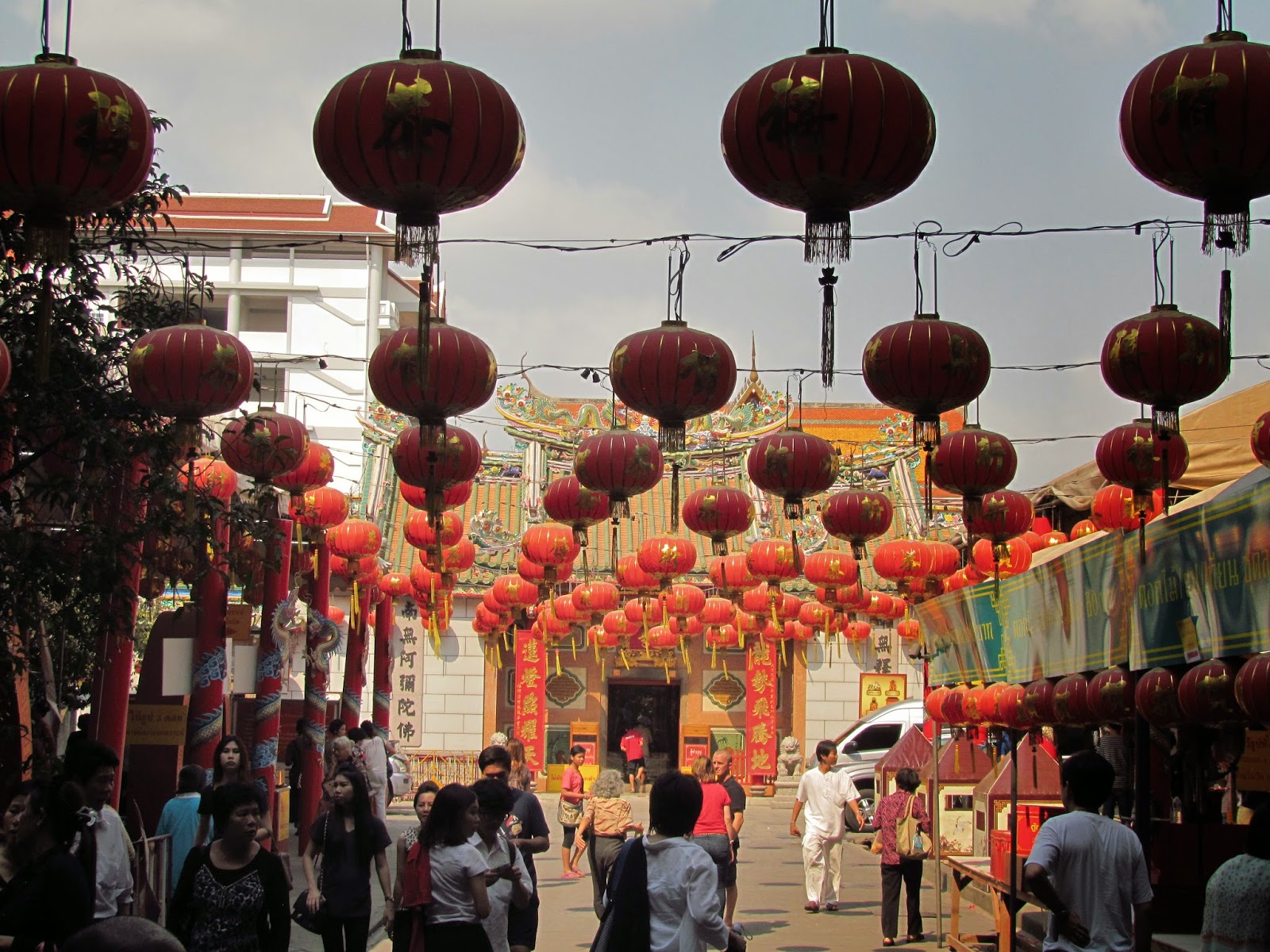
Dizzy and overwhelmed we walked out of Sampeng Lane, took a left into Itsaranuphap road and after only two blocks we got to the Talaat Kao, a 200 year old market, which has been acting as the central market and trading place of Chinatown.  A great place to discover the real cuisine of the Chinese.  Or to have a snake blood shot. Your call. Anyway, we are still full, so we decided to head towards Yaowarat Rd. then up to Charoen Khrung Rd. and pay a visit to the Leng Noi Yee Temple.  Built in 1871 and one of the most important temples for the Chinese community in Bangkok.  Here together with the regular services you can have your fortune told, make some merits, see funeral burning of paper cutouts offerings, or pray in a Confucian, Taoist or Buddhist altar.

Service at Leng Noi Yee Temple


Leng Noi Yee Temple
Mareados y abrumados salimos del pasaje Sampeng y doblamos a la izquierda en la calle Itsaranuphap con direccion al mercado Kao, un mercado que hace 200 anos de antiguedad actua como el centro de negocios del barrio.  Un gran lugar para probar la verdadera comida china, o un shot de sangre de serpiente, tu diras.  De cualquier manera, aun estamos llenos para cualquiera de las opciones asi que nos dirijimos hacia la calle Yaowarat y hasta la calle Charoen Khrung, para visitar el templo de Leng Noi Yee.  Construido en 1871 es uno de los mas importantes en Bangkok para la comunidad china.  Aqui ademas de los servicios regulares te pueden leer tu futuro, hacer meritos, ver la quema de ofrendas funerarias o rezarle a un altar Taoista, Confucianista o Budista.


China Gate


Wat Traimit
Now that we were in Chinatown's heart, there were still two places to visit before lunch.  So we headed down east on Charoeng Khrung Rd. until we reached the China Gate, also known as the Odeon Circle.  This is the mark of the limits of Chinatown. Then our second stop, although not Chinese, was in one of the most important temples in the city.  Wat Traimit, the Temple of the Golden Buddha, the world's largest solid gold Buddha statue. It is estimated that the statue was made during the Sukkhotai period (around the 13th or 14th century), it is 3mts tall and weighs over 5.5tons. The funny thing is that this golden statue was discovered by accident - when it was being moved to it's new location, one of the ropes snapped and the statue fell on the ground, then the plaster cover chipped showing the golden interior.  In 1935 the statue was settled in the old Wat Traimit building and since 2010 it rests in it's actual residence, making of Wat Traimit, one of the most visited temples in Thailand. The estimated cost of the statue is US$250 million, so at 40 bahts for entry fee, this Wat and the statue are very worth the visit. 

Ahora que ya estabamos en el centro del barrio chino, fuimos a ir a visitar dos sitios antes del almuerzo.  Asi que bajamos hacia el este por la calle Charoeng Khrung hasta llegar al Porton Chino, tambien conocido como el Circulo de Odeon. Esta estructura es la que marca el limite este del barrio chino.  Nuestra segunda parada, aunque no es china fue en unos de los templos mas importantes de la ciudad.  Wat Traimit, el templo del Buda de Oro, la estatua de Buda mas grande de oro solido en el mundo.  Se cree que fue construida durante el periodo Sukhotai (entre los siglos 13 y 14), tiene 3mts de alto y pesa mas de 5.5 tons.  Lo curioso es que esta fue descubierta por accidente - cuando la estaban llevando a su nueva locacion, una de las cuerdas se rompio y la estatua cayo al piso, esto causo que la cobertura de yeso se rompiera mostrando el interior dorado.  En 1935 la estatua se coloco en el antiguo edificio de Wat Traimit y desde el 2010 descansa en su actual residencia, esto hace que Wat Traimit sea uno de los templos mas visitados de Tailandia.  El costo estimado de la estatua es de unos US$250 millones, asi que por 40 bats la entrada, vale la pena.


Moo Satay with peanut sauce, sweet salad and toasts.
Now, to finish the day we headed for a local delicacy for lunch.  This is kind of two restaurants in one.  On one side you have Chongki Moo Satay (pork skewers) which come with a delicious peanut sauce and a mix of sweet cucumber, onion and chilli and the optional - and highly recommended - side order of toasts.  On the other side you have Khao Moo Dang Sri Morakot, this is also pork, but you can get 3 kinds of pork; bbq, fried or pork sausage, or the 3 of them mixed together.  The serving comes with rice and just like the skewers, it is delicious.


Khao Moo Dang 
Para terminar nuestro recorrido fuimos a un restaurante local para almorzar. Mas bien dicho a dos restaurantes en uno solo.  En un lado, Chongki Moo Satay, sirven una brochetas de cerdo con una deliciosa salsa de mani y una ensalada de pepino, cebolla y aji dulces y como opcion - muy recomendada - se acompanan con tostadas.  Al otro lado esta Khao Moo Dang Sri Morakot, aqui la estrella tambien es el cerdo, pero tienes 3 opciones a escoger; bbq, frito o chorizo de cerdo, o una mezcla de los tres.  Se sirven con arroz y al igual que las brochetas es delicioso.

After lunch, we walked towards the Hua Lamphong train/subway station (officially  called Krungthep station), taking a little walk through the station.  This is Thailand's main train station and from here you can take a train across the country or to Malaysia, Myanmar and even Singapore.  It was opened in 1916 and it is built in an Italian Neo-Renaissance style.


Despues de almorzar, caminamos hacia la estacion de tren y subterraneo de Hua Lamphong (oficialmente llamada estacion Krungthep) y decidimos darle una vuelta.  Esta es la estacion principal de tren de Tailandia y desde aqui se puede tomar un tren a cualquier punto del pais o a Malasia, Myanmar (Burma) o Singapur.  Se inauguro en 1916 y es una pieza del estilo neo renacentista italiano.


Hua Lamphong train station


Maybe next time, I will take a trip from Hua Lampong to inspire my next exploration.  I will let my legs decide.


Tal vez la proxima vez, hare un viaje desde Hua Lamphong para inspirar my proxima aventura.  Que mis piernas decidan.


Tuesday, 10 June 2014

Take a walk on the green side - Caminando en el lado verde

One of the most unusual places to visit for farangs in Krung Thep, is the so called “Green Great Lungs of Bangkok”.  A huge portion of land, on the southern banks of the Chao Praya River, right across the famous Klong Toey market and district.  After years – or just days - in Bangkok and it’s crazy concrete jungle that never stops, Bang Krachao appears as an escape, a green oasis. Without much effort you can disappear for hours, or days, and explore rivers, swamps, plantation fields, local floating markets and become a first-line observer of a very unknown and laid back lifestyle, right in the heart – or lungs - of Bangkok.

Uno de los sitios menos visitados por turistas en Bangkok, es el llamado "Los Pulmones de Bangkok".  Una enorme porcion de tierra al sur del rio Chao Phraya, justo al frente del ditrito de Klong Toey.  Despues de estar anos, o solo dias, sumergido en Bangkok y su alocada selva de concreto, Bang Krachao es un gran respiro. Sin mucho esfuerzo se puede desaparecer por horas - o dias - y explorar rios, pantanos, canales, plantaciones, mercados y ver de cerca una parte desconocida de la vida mas relajada en el corazon, o mejor dicho, los pulmones, de Krung Thep.

So after reading as much as we could about it, Elaine –my adventures sidekick- and I, decided to spend a weekend exploring this green paradise.  It is really easy to get there.  You just have to take the subway up to Klong Toey Station and then walk for about half an hour through the Klong Toey area.

Despues de leer todo lo que pudimos, Elaine y yo decidimos pasar un fin de semana explorando este oceano verde.  Para llegar hay que tomar el subterraneo hasta la estacion de Klong Toey y caminar una media hora a trves de este famoso distrito.

Not a very exciting walk to start the day, but on the way you can check out the Klong Toey Market, one of Bangkok’s most famous markets - a bit smelly, if you are not used to fresh fish and meat (fresh meaning alive – caged chickens, birds and frogs) and then take a look at the back streets of what once known and still can be, one of the most dangerous areas of Bangkok.

Camino al muelle, se puede pasar por el mercado de Klong Toey, uno de los mas famosos de la ciudad, y disfrutar de su fauna.  Aqui hay todo tipo de aves y carnes a la venta, incluidas ranas y ratas, verduras, frutas y todo lo que uno se pueda imaginar. 

The stunning Wat Klong Toey Nai
Once out of the MRT station, just walk east on Rama IV until you hit Sunthon Kosa. There, take a right. After crossing Rama III, Sunthon Kosa changes name to Na Ranong Alley, you just gotta keep on going straight, until you get to Soi Wat Klong Thoei Nai. Take a left into the Soi and it will take you towards a big wat and then, after you go through it, you will find yourself at the Bang Krachao Pier.  A small pier only for small ferry boats which cross the river, for 7 bahts.

Al salir del subterraneo, caminamos por la avenida Rama IV hasta llegar al cruce con Sunthon Kosa.  Doblamos a la derecha y bajamos derecho hasta llegar al templo de Wat Klong Toey.  Entramos y cruzamos el templo y llegamos al muelle de Bang Krachao.  Un pequeno muelle donde por un sol tomamos un pequeno ferry que nos lleva a nuestro destino.

Bang Krachao pier
As soon as you land on the other side, you will find a bicycle rental shop, right on the pier.  One bike costs 40 bahts for the whole day, so this is where we stopped walking and started riding.  Just make sure the tires are pumped and that the brakes brake! Now, Bang Krachao is completely covered by vegetation, swamps and minor canals, where the locals have developed a system of “high paths” (about 1.5mts) that take you anywhere you need to go. Although, the paths are wide enough most of the time, they might become quite a challenge if you are a nervous or wobbly biker, narrow sections and 90 degrees turn do demand a little bit of experience and concentration… or you might end up with not only your clothes wet but also your pride.

Al llegar a la orilla contraria hay una tienda donde alquilan bicicletas. Todo un dia por 3.50 soles, la mejor forma para explorar la zona. Bang Krachao esta completamente cubierto por vegetacion, canales y pantanos y los locales han desarrollado un sistema de "veredas altas" que te llevan adonde quieras ir.  Aunque estos caminos son suficientemente anchos, hay secciones muy angostas y curvas de 90 grados donde si eres un ciclista nervioso y con poca experiencia puedes terminar metido en el agua, con el orgullo empapado.

The local bike paths
Probably the worst thing is that there are NO maps of these paths, so try to know always which direction you are heading and where the main roads are.  It’s not really that hard and there is always a main road around.  At some points you can find some panels with “maps” of the area and if you take a picture of this they might be of great navigation aid.  One handy piece of advice would be to try to start biking as early as you can, the sun gets extremely strong here.

Lo peor de bang Krachao es que no hay buenos mapas de los caminos.  Por eso hay que tratar de saber hacia donde estan las vias principales.  La verdad no es tan dificil y siempre hay una cerca.  En algunos puntos hay paneles con "mapas" del area y si les tomas una foto te ayudan mucho con la navegacion.  Un buen consejo?  Empieza tu recorrido lo mas temprano que puedas, ya que despues el sol te castiga fuerte.

The easiest spot to get to from the pier is the Sri Nakhon Khuean Khan Botanical Park.  Just follow Soi Wat Pat Rangsan until you see the entrance to a big park. Can't miss it. Here you will not only find bike paths with very few or no people at all, but a few high view points from where you can see Bangkok behind an ocean of green. Quite an usual sight.  After you've explored and ridden the park, it is time to properly immerse yourself in a labyrinth of "floating" paths and their insane 90 degrees turns.  Just go out of the park and turn left and another left into the first cement high path you see.  You will be having an amazing ride in a maze of paths and minor paths - some only visible in dry season - that will be taking you through houses, farms, restaurants, temples, local shops and all of them with one thing in common, you can barely see them from the paths!  

Al salir del muelle, el sitio mas facil para llegar es el Parque Botanico Sri Nakhon Khuean. Vamos derecho por Soi Wat Pat Rangsan hasta llegar a la entrada al parque. Aqui no solo encontramos caminos a traves de la vegetacion con muy muy poca gente, sino tambien algunos miradores desde donde se puede ver Bangkok detras de un mar verde, un panorama bastante inusual. Despues de explorar el parque, es hora de infiltrarse en el laberinto de caminos "aereos" y curvas super cerradas. Asi que salimos del parque, doblamos a la izquierda y en el primer camino que vemos doblamos a la izquierda de nuevo.  La verdad no teniamos idea de cuanto nos ibamos a divertir. Algunos caminos son mas anchos y faciles, pero otros, menores son un buen reto - algunos solo se pueden usar en temporada seca - y te llevan a traves de casas, granjas, restaurantes, templos, negocios, todos ellos con algo en comun; casi no los puedes ver desde el camino asi que hay que estar atento.

Local and delicious fruits are available everywhere

Grilled Catfish with Thai Herbs!!
By now and after a few hours riding, it will be time for you to find a good place for lunch. Located along Petchahung Alley there is quite a few local restaurants.  A really good recommendation for lunch? Try the whole grilled catfish with Thai herbs. Superlative! Accompanied by fried rice with shrimps and one, two or three ice cold beers, makes the day perfect…. By now you will definitely be feeling the after lunch effect - combined with too much sun - laziness! So it might be time to find a place to spend the night.  

Despues de un buen rato andando decidimos que es hora de almorzar.  En la calle Petchanung hay varios restaurantes locales donde probamos una de las especialidades de la zona, pez gato a la parrilla con hierbas tailandesas.  Delicioso!  Con arroz con langostinos y una, dos o tres cervezas frias, perfecto.
Obviamente despues de tremendo almuerzo ya es hora de empezara a buscar un sitio para pasar la noche.

The Bangkok Tree House Eco-Hotel
We really liked the look and concept of the Bangkok Tree House. With just a few rooms, this eco-hotel is made out of recycled wood and materials, with its own orchard of vegetables and philosophy of using as much alternative fuel and energy as possible.  As they say on their website, they are not a place for anyone. And they mean it! There are hundreds of different bugs and creepy crawlies (not in your bed) including huge monitor river lizards; the toilets floors are see through and showers are out-doors; they do have wifi but no tv, the food is spectacular as is the view. If you like the thought of a true eco - retreat in the middle of a metropolis like Bangkok, then this place is definitely worth the price and time spent there. Beautifully designed rooms, great food (worth saying it twice) and peace and quiet, an extremely unusual combination for Bangkok.

Nos gusto mucho el concepto del Bangkok Tree House.  Un eco-hotel construido todo con materiales y madera reciclados.  Tiene muy pocos cuartos, muy bien disenados, su propio huerto y una filosofia de usar la mayor cantidad posible de combustible y energia alternativos posible.  En su website dicen que no son un lugar para cualquiera y lo dicen en serio.  Hay cientos de diferentes insectos por todos lados (menos en las camas), enromes lagartos monitor, los pisos de los banos no son completamante cerrados y las duchas son al aire libre, hay wifi pero no tv y la comida y las vistas son espectaculares.  Si estas buscando un verdadero escape de la ciudad sin salir de la ciudad, es el mejor lugar de lejos en Bangkok.

This being said and after a full day of exploring by bicycle, it wasn't a surprise that we had an incredible night of sleep and rest.  The next morning, late and after a delicious breakfast, we thought we still needed to explore more before returning to the grey jungle. So, we pointed our feet towards the Bang Namphueng Floating Market, which is just a short walk from the Bangkok Tree House.

Habiendo dicho esto y despues de un dia de full exploracion no era sorpresa que esa noche durmamos increiblemente.  La paz y el silencio del lugar son espectaculares.  A la manana siguiente y despues de un delicioso y contundente desayuno, aun teniamos mucho por explorar antes de regresar a la jungla de concreto.  Asi q dirijimos nustros pies hacia el mercado flotante de Bang Namphueng y empezamos a caminar.

Open only on weekends, this is where you will find all the fauna of Bang Krachao interacting together.  Locals or outsiders.  Or even farangs.  In this market you will find an infinity of things, from typical ice or hot coffees, to little river fish deep fried and served with different sauces.  All kinds and colour of rice, noodles and meat! Snacks, pastries, handcrafts, clothing's, musical instruments, etc, etc and as many etc's as your mind can imagine.

El mercado soloolo abre los fines de semana y es aqui donde encontramos toda la fauna de Bang Krachao en un mismo lugar. Locales y no locales, incluidos muy pocos extranjeros. Todos disfrutando de todas las cosas que puedes encontrar, cafes, tes y postres tipicos de Tailandia, diferentes peces de rio fritos y servidos en diferentes salsas.  Arroz, fideos de todos los colores, carnes, antojos, dulces, artesanias, ropa, incluso instrumentos musicales, etc etc y tantos etc's como te puedas imaginar.

A really nice and cool place to spend a couple of hours, having a beer and watching people interact and just getting lost in the dynamics and flow of a real small town local floating market, without actually been a floating one! Let me explain. The market is right next to a canal and although a few of the vendors are on boats, which actually don’t move, most of the vendors and stalls are on firm ground.

Un gran sitio para pasar un par de horas dedicandonos a "observar gente" mientras disfrutamos unas cervezas y nos perdemos en la dinamica y el feeling de un mercado, local, pequeno y real.

Enjoying time with the locals.
By now we agreed that it was time for us to go and so we started our way back home. First, we headed back towards the Tree House, to collect our bags and cross the river. The way we came to Bang Krachao can easily be done backwards, but to make things a bit more interesting we took a different route. We went to a small local pier called Peppermint Ferry Pier located only 10 minutes walking from the Tree House and this time, for only 4thb we crossed the river.  From here and due to the long distance to cover (it’s about 10 minutes by taxi, so that makes it a very long walk) and our super mellow mood we taxi to the skytrain Bang Na Station. A half an hour skytrain ride later we get to Asoke, thinking what an amazing walk we had this weekend and where will our feet take us next time.

Despues de explorar el mercado y sus alrededores por unas horas y seguir llenandonos la panza con las delicias locales se acerca la hora de regresar a casa. Primero regresamos al Tree House a recoger nuestras mochilas y despues a cruzar el rio. La forma como vinimos puede ser usada de regreso, pero queriamos hacerlo de una forma diferente e interesante, asi que fuimos a un pequeno muelle local llamado muelle Peppermint (menta), a solo 10 minutos caminando y desde ahi por 4baths (menos de un sol) cruzamos el Chao Phraya por ultima vez. Desde el muelle es una larga caminata hasta la estacion del tren electrico asi que terminamos tomando un taxi hasta la estacion de Bang Na, desde donde tomamos el tren hasta la estacion de Asoke, mientras miramos por la ventana y pensamos en las caras tan diferentes que tiene esta ciudad y adonde caminaremos la proxima vez.

Information on the places visited and transport used / Informacion de los lugares visitados y el transporte usado.
The Tree House Bangkok
BTS Bang Na Station
MRT Bang Na Station
Complete guide to public transport in Bangkok