Caminando por Bangkok

Los ultimos 3 anos, he vivido, descubierto, probado y explorado lo que es vivir en esta fantastica ciudad. Ahora es tiempo de compartir mis historias.

Wednesday, 23 July 2014

Walking around Chinatown & Little India - Caminando por el barrio chino y la pequena India

For thousands of years the Chinese have been exploring, settling, influencing and have become an active part of Asia's commerce and business life.  And their presence in Singapore, Malaysia, Laos, Vietnam and Thailand can be seen everywhere.  In many cities of the world nowadays we can find a Chinatown area, and probably one of the most real - which keeps alive it's traditions and celebrations - is the Chinatown in Bangkok.  For the last 100 years (since October 15, 1915) Chinatown has been growing together with Bangkok. 


Durante miles de anos, la cultura china ha explorado, colonizado, influenciado y se ha convertido en un lider de la vida comercial de Asia.  Y su presencia en Laos, Singapur, Malasia, Vietnam y Tailandia se puede ver en cualquier lugar. Es mas, en muchas ciudades del mundo podemos encontrar un barrio chino y tal vez, uno de los mas reales, donde se mantienen vivas las tradiciones y costumbres, es el barrio chino en Bangkok. Desde el 15 de octubre de 1915, hace casi 100 anos, el barrio chino ha crecido junto con Bangkok.


Visiting Chinatown is definitely a mind blowing experience.  There is people everywhere!  Coming in and out of alleys which you might never notice, which end in hidden temples, flooded by incense smoke, or more alleys.  The strong smell from food stalls cooking typical delicacies is everywhere. Hundreds of motorcycles coming from every direction and delivery trolleys carrying the most unexpected goods between shops. Chinatown can make any day an incredible day.

Visitar el barrio chino es una experiencia unica.  Hay gente por todos lados, entrando y saliendo de callejones que ni te habias dado cuenta que estaban ahi, que terminan en templos escondidos, inundados por el humo de los inciensos, o en otros callejones.  El fuerte olor de los puestos donde se cocinan las delicias tipicas lo abarca todo.  Cientos de motocicletas fluyen en todas las direcciones posibles, igual que los cargadores, llevando los mas inesperados productos entre tiendas. En este barrio cualquier dia, puede ser un dia increible.


Wat Rajaburana
So, after deciding how we were going to submerge ourselves in this neighborhood, we made our way to the Memorial Bridge pier.  If you get to Chao Phraya river, no matter where, at any pier, just jump into one of the Orange Flag taxi boats and for 15 bahts you will get there. Easy!  Right next to the pier you will find the Memorial Park and right in front of it you will see Wat Rajaburana, also known as Wat Liab.  (For some weird reason i still don't understand, everything in Thailand seems to have two or three names).  The wat was built in the 15th century under the reign of King Sam Phraya and during the late 1700's it was the seat of the Head Monk Patriarch of the Thai Sangha (Buddhist Assmebly).  The temple deserves a visit, as it holds over 80 statues that were evacuated from Ayuthaya when the Burmese invaded the city in 1767. 

Entonces, despues de decidir como ibamos a sumergirnos en este barrio, fuimos en bote hasta el muelle del Memorial Bridge.  Desde cualquier muelle en el Chao Phraya te puedes tomar un bote de bandera naranja y por 15 bahts llegas. Facil.  Justo al lado del muelle esta el Parque Memorial y al frente se puede ver el Wat Rajaburana, tambien llamado Wat Liab. (Por alguna razon, que hasta ahora no entiendo, todo en Tailandia tiene dos o tres nombres). Fue construido en el siglo 15 bajo el reinado de Sam Phraya y en la segunda mitad de los 1700 fue el trono del Monje Patriarca del Thai Sangha (la Asamblea Budista). El templo merece una visita ya que contiene unas 80 estatuas que fueron evacuadas desde Ayuthaya cuando los burmeses invadieron la ciudad en 1767.


Continuing up into Chinatown itself, we decided to make a short detour and walked up north by Triphet Rd. into the Indian area, also known as Little India.
Not a very big area, but as it turned out, a very big surprise. First of all, people change.  Sikhs and Muslims now flow out from every corner and the language, the background music, the smells, the food, is different. After exploring the fantastic Pahurat Cloth Market, we found a small samosas stand on an alley on Chakraphet Rd. and next to an impressive Sikh Temple, Sri Guru Singh Sabha. The samosas and tikki (deep fried dumplings stuffed with potatoes) that Raspal Singh offers are outstanding.  For 8 bahts per bite you can delight in a delicious Indian combo, served with a delicious sweet sour sauce that will make you lick your fingers.

Continuando hacia el barrio chino, decidimos hacer un pequeno desvio por la calle Triphet hacia el barrio indio, conocido como la Pequena India. No es un area muy grande, pero si una gran sorpresa.  Primero porque la gente cambia. Sikhs y musulmanes salen de todas las esquinas y el lenguaje, la musica, los olores, la comida, todo, es diferente.  Despues de recorrer el mercado Pahurat encontramos un puesto de samosas (como unas empanadas) en un callejon, sobre la avenida Chakraphet y junto al Sri Guru Singh Sabha, un impresionante templo Sikh.  Las samosas y el tikki (frituras rellenas de papa) de Raspal Singha resultaron increibles, por solo 8 bahts (menos de un sol) por pieza puedes disfrutar un delicioso combo indio, servido con una deliciosa salsa agri dulce que va a hacer que te chupes los dedos.


Tikki, samosas & sweet sour sauce.


"Pet" crocodile
So, belly full after our snack, we headed towards something we really wanted to see. Next to Wat Chakkrawat, in a labyrinth of alleys, there is a small monk's residential area, where in a pond the monks keep, we had read, a very unusual pet.  A giant crocodile.  We were not only surprised to find this was true, but also by the size of this "pet".  He - or she - was almost the size of the pond! maybe 5mts long? When we wondered what they would be feeding this big fellow with, we realized...we hadn't seen any dogs or cats for a while.  Unfortunately there weren't any monks around to ask.

Con la barriga llena nos dirigimos hacia un destino que teniamos muchas ganas de ver.  Al lado de Wat Chakkrawat, en un laberinto de callejones hay un complejo residencial de monjes, donde en un pequeno estanque, los monjes tienen una inusual mascota.  Un cocodrilo gigante. Nuestra sorpresa no solo fue ver que esto era verdad, sino al ver el tamano de esta mascota.  El - o la - cocodrilo media unos 5mts.  Cuando nos pusimos a pensar en como alimentarian a tremendo animal, nos dimos cuenta, que en un buen rato, no habiamos visto perros ni gatos.  Para nuestra mala suerte no habia ningun monje a quien preguntarle.

  
Therefore we just kept on going finally into the heart of Chinatown.  So we took Sampeng Lane, once Chinatown's main road and now a mega street market lane. Here you can find anything you want and a lot that you don't want. Shops specialize in what they sell; plastic shoes, hair bobbles, belts, dried shrimp, pet stores (no crocodiles though), zippers, watches, coin purses, t-shirts, underwear, velcro, sweets, boxes, restaurants, plastic bags, pens, etc, etc, etc. No wonder that the Chinese community is a major part of the business in the city.  These lane alone, goes for more than 20 blocks full of stands, shops and walking sellers.  

Asi q decidimos seguir hacia el corazon del barrio chino.  Subimos por el pasaje Sampeng, una vez la calle principal del barrio convertida en un mega-mercado callejero, donde se puede encontrar absolutamente de todo.  Aqui las tiendas en verdad se especializan en lo que venden; zapatos de plastico, ligas para el pelo, correas, charqui de langostino, tiendas de mascotas (sin cocodrilos), zierres, relojes, monederos, polos, ropa interior, pega-pega, dulces, cajas, restaurantes, bolsas, lapiceros, etc, etc, etc.  No queda ninguna duda de porque la comunidad china es la tajada mas grande del mercado de la ciudad.  Solo este pasaje, tiene mas de 20 cuadras llenas de tiendas, puestos y vendedores ambulantes.


Dizzy and overwhelmed we walked out of Sampeng Lane, took a left into Itsaranuphap road and after only two blocks we got to the Talaat Kao, a 200 year old market, which has been acting as the central market and trading place of Chinatown.  A great place to discover the real cuisine of the Chinese.  Or to have a snake blood shot. Your call. Anyway, we are still full, so we decided to head towards Yaowarat Rd. then up to Charoen Khrung Rd. and pay a visit to the Leng Noi Yee Temple.  Built in 1871 and one of the most important temples for the Chinese community in Bangkok.  Here together with the regular services you can have your fortune told, make some merits, see funeral burning of paper cutouts offerings, or pray in a Confucian, Taoist or Buddhist altar.

Service at Leng Noi Yee Temple


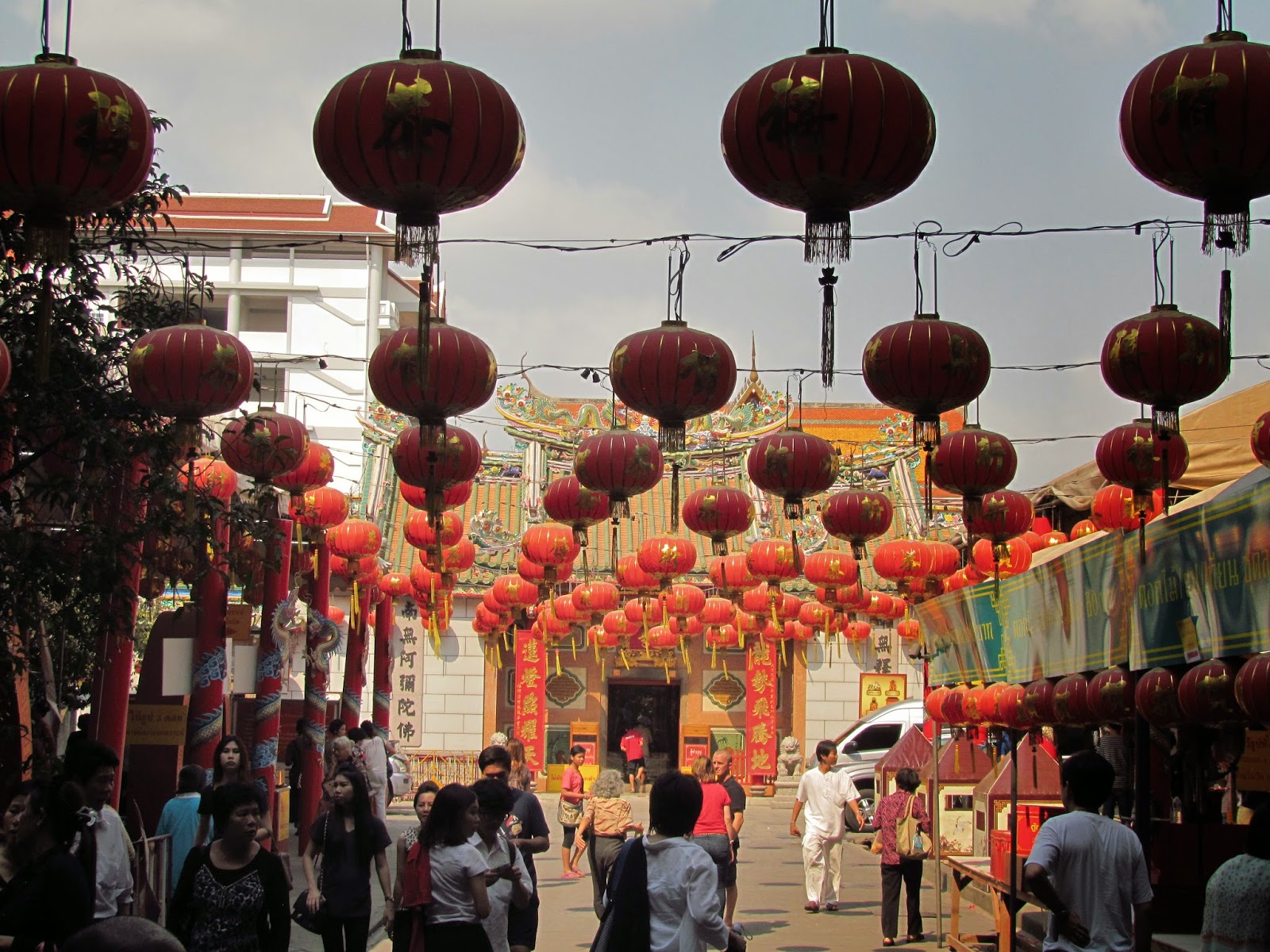
Leng Noi Yee Temple
Mareados y abrumados salimos del pasaje Sampeng y doblamos a la izquierda en la calle Itsaranuphap con direccion al mercado Kao, un mercado que hace 200 anos de antiguedad actua como el centro de negocios del barrio.  Un gran lugar para probar la verdadera comida china, o un shot de sangre de serpiente, tu diras.  De cualquier manera, aun estamos llenos para cualquiera de las opciones asi que nos dirijimos hacia la calle Yaowarat y hasta la calle Charoen Khrung, para visitar el templo de Leng Noi Yee.  Construido en 1871 es uno de los mas importantes en Bangkok para la comunidad china.  Aqui ademas de los servicios regulares te pueden leer tu futuro, hacer meritos, ver la quema de ofrendas funerarias o rezarle a un altar Taoista, Confucianista o Budista.


China Gate


Wat Traimit
Now that we were in Chinatown's heart, there were still two places to visit before lunch.  So we headed down east on Charoeng Khrung Rd. until we reached the China Gate, also known as the Odeon Circle.  This is the mark of the limits of Chinatown. Then our second stop, although not Chinese, was in one of the most important temples in the city.  Wat Traimit, the Temple of the Golden Buddha, the world's largest solid gold Buddha statue. It is estimated that the statue was made during the Sukkhotai period (around the 13th or 14th century), it is 3mts tall and weighs over 5.5tons. The funny thing is that this golden statue was discovered by accident - when it was being moved to it's new location, one of the ropes snapped and the statue fell on the ground, then the plaster cover chipped showing the golden interior.  In 1935 the statue was settled in the old Wat Traimit building and since 2010 it rests in it's actual residence, making of Wat Traimit, one of the most visited temples in Thailand. The estimated cost of the statue is US$250 million, so at 40 bahts for entry fee, this Wat and the statue are very worth the visit. 

Ahora que ya estabamos en el centro del barrio chino, fuimos a ir a visitar dos sitios antes del almuerzo.  Asi que bajamos hacia el este por la calle Charoeng Khrung hasta llegar al Porton Chino, tambien conocido como el Circulo de Odeon. Esta estructura es la que marca el limite este del barrio chino.  Nuestra segunda parada, aunque no es china fue en unos de los templos mas importantes de la ciudad.  Wat Traimit, el templo del Buda de Oro, la estatua de Buda mas grande de oro solido en el mundo.  Se cree que fue construida durante el periodo Sukhotai (entre los siglos 13 y 14), tiene 3mts de alto y pesa mas de 5.5 tons.  Lo curioso es que esta fue descubierta por accidente - cuando la estaban llevando a su nueva locacion, una de las cuerdas se rompio y la estatua cayo al piso, esto causo que la cobertura de yeso se rompiera mostrando el interior dorado.  En 1935 la estatua se coloco en el antiguo edificio de Wat Traimit y desde el 2010 descansa en su actual residencia, esto hace que Wat Traimit sea uno de los templos mas visitados de Tailandia.  El costo estimado de la estatua es de unos US$250 millones, asi que por 40 bats la entrada, vale la pena.


Moo Satay with peanut sauce, sweet salad and toasts.
Now, to finish the day we headed for a local delicacy for lunch.  This is kind of two restaurants in one.  On one side you have Chongki Moo Satay (pork skewers) which come with a delicious peanut sauce and a mix of sweet cucumber, onion and chilli and the optional - and highly recommended - side order of toasts.  On the other side you have Khao Moo Dang Sri Morakot, this is also pork, but you can get 3 kinds of pork; bbq, fried or pork sausage, or the 3 of them mixed together.  The serving comes with rice and just like the skewers, it is delicious.


Khao Moo Dang 
Para terminar nuestro recorrido fuimos a un restaurante local para almorzar. Mas bien dicho a dos restaurantes en uno solo.  En un lado, Chongki Moo Satay, sirven una brochetas de cerdo con una deliciosa salsa de mani y una ensalada de pepino, cebolla y aji dulces y como opcion - muy recomendada - se acompanan con tostadas.  Al otro lado esta Khao Moo Dang Sri Morakot, aqui la estrella tambien es el cerdo, pero tienes 3 opciones a escoger; bbq, frito o chorizo de cerdo, o una mezcla de los tres.  Se sirven con arroz y al igual que las brochetas es delicioso.

After lunch, we walked towards the Hua Lamphong train/subway station (officially  called Krungthep station), taking a little walk through the station.  This is Thailand's main train station and from here you can take a train across the country or to Malaysia, Myanmar and even Singapore.  It was opened in 1916 and it is built in an Italian Neo-Renaissance style.


Despues de almorzar, caminamos hacia la estacion de tren y subterraneo de Hua Lamphong (oficialmente llamada estacion Krungthep) y decidimos darle una vuelta.  Esta es la estacion principal de tren de Tailandia y desde aqui se puede tomar un tren a cualquier punto del pais o a Malasia, Myanmar (Burma) o Singapur.  Se inauguro en 1916 y es una pieza del estilo neo renacentista italiano.


Hua Lamphong train station


Maybe next time, I will take a trip from Hua Lampong to inspire my next exploration.  I will let my legs decide.


Tal vez la proxima vez, hare un viaje desde Hua Lamphong para inspirar my proxima aventura.  Que mis piernas decidan.


Tuesday, 10 June 2014

Take a walk on the green side - Caminando en el lado verde

One of the most unusual places to visit for farangs in Krung Thep, is the so called “Green Great Lungs of Bangkok”.  A huge portion of land, on the southern banks of the Chao Praya River, right across the famous Klong Toey market and district.  After years – or just days - in Bangkok and it’s crazy concrete jungle that never stops, Bang Krachao appears as an escape, a green oasis. Without much effort you can disappear for hours, or days, and explore rivers, swamps, plantation fields, local floating markets and become a first-line observer of a very unknown and laid back lifestyle, right in the heart – or lungs - of Bangkok.

Uno de los sitios menos visitados por turistas en Bangkok, es el llamado "Los Pulmones de Bangkok".  Una enorme porcion de tierra al sur del rio Chao Phraya, justo al frente del ditrito de Klong Toey.  Despues de estar anos, o solo dias, sumergido en Bangkok y su alocada selva de concreto, Bang Krachao es un gran respiro. Sin mucho esfuerzo se puede desaparecer por horas - o dias - y explorar rios, pantanos, canales, plantaciones, mercados y ver de cerca una parte desconocida de la vida mas relajada en el corazon, o mejor dicho, los pulmones, de Krung Thep.

So after reading as much as we could about it, Elaine –my adventures sidekick- and I, decided to spend a weekend exploring this green paradise.  It is really easy to get there.  You just have to take the subway up to Klong Toey Station and then walk for about half an hour through the Klong Toey area.

Despues de leer todo lo que pudimos, Elaine y yo decidimos pasar un fin de semana explorando este oceano verde.  Para llegar hay que tomar el subterraneo hasta la estacion de Klong Toey y caminar una media hora a trves de este famoso distrito.

Not a very exciting walk to start the day, but on the way you can check out the Klong Toey Market, one of Bangkok’s most famous markets - a bit smelly, if you are not used to fresh fish and meat (fresh meaning alive – caged chickens, birds and frogs) and then take a look at the back streets of what once known and still can be, one of the most dangerous areas of Bangkok.

Camino al muelle, se puede pasar por el mercado de Klong Toey, uno de los mas famosos de la ciudad, y disfrutar de su fauna.  Aqui hay todo tipo de aves y carnes a la venta, incluidas ranas y ratas, verduras, frutas y todo lo que uno se pueda imaginar. 

The stunning Wat Klong Toey Nai
Once out of the MRT station, just walk east on Rama IV until you hit Sunthon Kosa. There, take a right. After crossing Rama III, Sunthon Kosa changes name to Na Ranong Alley, you just gotta keep on going straight, until you get to Soi Wat Klong Thoei Nai. Take a left into the Soi and it will take you towards a big wat and then, after you go through it, you will find yourself at the Bang Krachao Pier.  A small pier only for small ferry boats which cross the river, for 7 bahts.

Al salir del subterraneo, caminamos por la avenida Rama IV hasta llegar al cruce con Sunthon Kosa.  Doblamos a la derecha y bajamos derecho hasta llegar al templo de Wat Klong Toey.  Entramos y cruzamos el templo y llegamos al muelle de Bang Krachao.  Un pequeno muelle donde por un sol tomamos un pequeno ferry que nos lleva a nuestro destino.

Bang Krachao pier
As soon as you land on the other side, you will find a bicycle rental shop, right on the pier.  One bike costs 40 bahts for the whole day, so this is where we stopped walking and started riding.  Just make sure the tires are pumped and that the brakes brake! Now, Bang Krachao is completely covered by vegetation, swamps and minor canals, where the locals have developed a system of “high paths” (about 1.5mts) that take you anywhere you need to go. Although, the paths are wide enough most of the time, they might become quite a challenge if you are a nervous or wobbly biker, narrow sections and 90 degrees turn do demand a little bit of experience and concentration… or you might end up with not only your clothes wet but also your pride.

Al llegar a la orilla contraria hay una tienda donde alquilan bicicletas. Todo un dia por 3.50 soles, la mejor forma para explorar la zona. Bang Krachao esta completamente cubierto por vegetacion, canales y pantanos y los locales han desarrollado un sistema de "veredas altas" que te llevan adonde quieras ir.  Aunque estos caminos son suficientemente anchos, hay secciones muy angostas y curvas de 90 grados donde si eres un ciclista nervioso y con poca experiencia puedes terminar metido en el agua, con el orgullo empapado.

The local bike paths
Probably the worst thing is that there are NO maps of these paths, so try to know always which direction you are heading and where the main roads are.  It’s not really that hard and there is always a main road around.  At some points you can find some panels with “maps” of the area and if you take a picture of this they might be of great navigation aid.  One handy piece of advice would be to try to start biking as early as you can, the sun gets extremely strong here.

Lo peor de bang Krachao es que no hay buenos mapas de los caminos.  Por eso hay que tratar de saber hacia donde estan las vias principales.  La verdad no es tan dificil y siempre hay una cerca.  En algunos puntos hay paneles con "mapas" del area y si les tomas una foto te ayudan mucho con la navegacion.  Un buen consejo?  Empieza tu recorrido lo mas temprano que puedas, ya que despues el sol te castiga fuerte.

The easiest spot to get to from the pier is the Sri Nakhon Khuean Khan Botanical Park.  Just follow Soi Wat Pat Rangsan until you see the entrance to a big park. Can't miss it. Here you will not only find bike paths with very few or no people at all, but a few high view points from where you can see Bangkok behind an ocean of green. Quite an usual sight.  After you've explored and ridden the park, it is time to properly immerse yourself in a labyrinth of "floating" paths and their insane 90 degrees turns.  Just go out of the park and turn left and another left into the first cement high path you see.  You will be having an amazing ride in a maze of paths and minor paths - some only visible in dry season - that will be taking you through houses, farms, restaurants, temples, local shops and all of them with one thing in common, you can barely see them from the paths!  

Al salir del muelle, el sitio mas facil para llegar es el Parque Botanico Sri Nakhon Khuean. Vamos derecho por Soi Wat Pat Rangsan hasta llegar a la entrada al parque. Aqui no solo encontramos caminos a traves de la vegetacion con muy muy poca gente, sino tambien algunos miradores desde donde se puede ver Bangkok detras de un mar verde, un panorama bastante inusual. Despues de explorar el parque, es hora de infiltrarse en el laberinto de caminos "aereos" y curvas super cerradas. Asi que salimos del parque, doblamos a la izquierda y en el primer camino que vemos doblamos a la izquierda de nuevo.  La verdad no teniamos idea de cuanto nos ibamos a divertir. Algunos caminos son mas anchos y faciles, pero otros, menores son un buen reto - algunos solo se pueden usar en temporada seca - y te llevan a traves de casas, granjas, restaurantes, templos, negocios, todos ellos con algo en comun; casi no los puedes ver desde el camino asi que hay que estar atento.

Local and delicious fruits are available everywhere

Grilled Catfish with Thai Herbs!!
By now and after a few hours riding, it will be time for you to find a good place for lunch. Located along Petchahung Alley there is quite a few local restaurants.  A really good recommendation for lunch? Try the whole grilled catfish with Thai herbs. Superlative! Accompanied by fried rice with shrimps and one, two or three ice cold beers, makes the day perfect…. By now you will definitely be feeling the after lunch effect - combined with too much sun - laziness! So it might be time to find a place to spend the night.  

Despues de un buen rato andando decidimos que es hora de almorzar.  En la calle Petchanung hay varios restaurantes locales donde probamos una de las especialidades de la zona, pez gato a la parrilla con hierbas tailandesas.  Delicioso!  Con arroz con langostinos y una, dos o tres cervezas frias, perfecto.
Obviamente despues de tremendo almuerzo ya es hora de empezara a buscar un sitio para pasar la noche.

The Bangkok Tree House Eco-Hotel
We really liked the look and concept of the Bangkok Tree House. With just a few rooms, this eco-hotel is made out of recycled wood and materials, with its own orchard of vegetables and philosophy of using as much alternative fuel and energy as possible.  As they say on their website, they are not a place for anyone. And they mean it! There are hundreds of different bugs and creepy crawlies (not in your bed) including huge monitor river lizards; the toilets floors are see through and showers are out-doors; they do have wifi but no tv, the food is spectacular as is the view. If you like the thought of a true eco - retreat in the middle of a metropolis like Bangkok, then this place is definitely worth the price and time spent there. Beautifully designed rooms, great food (worth saying it twice) and peace and quiet, an extremely unusual combination for Bangkok.

Nos gusto mucho el concepto del Bangkok Tree House.  Un eco-hotel construido todo con materiales y madera reciclados.  Tiene muy pocos cuartos, muy bien disenados, su propio huerto y una filosofia de usar la mayor cantidad posible de combustible y energia alternativos posible.  En su website dicen que no son un lugar para cualquiera y lo dicen en serio.  Hay cientos de diferentes insectos por todos lados (menos en las camas), enromes lagartos monitor, los pisos de los banos no son completamante cerrados y las duchas son al aire libre, hay wifi pero no tv y la comida y las vistas son espectaculares.  Si estas buscando un verdadero escape de la ciudad sin salir de la ciudad, es el mejor lugar de lejos en Bangkok.

This being said and after a full day of exploring by bicycle, it wasn't a surprise that we had an incredible night of sleep and rest.  The next morning, late and after a delicious breakfast, we thought we still needed to explore more before returning to the grey jungle. So, we pointed our feet towards the Bang Namphueng Floating Market, which is just a short walk from the Bangkok Tree House.

Habiendo dicho esto y despues de un dia de full exploracion no era sorpresa que esa noche durmamos increiblemente.  La paz y el silencio del lugar son espectaculares.  A la manana siguiente y despues de un delicioso y contundente desayuno, aun teniamos mucho por explorar antes de regresar a la jungla de concreto.  Asi q dirijimos nustros pies hacia el mercado flotante de Bang Namphueng y empezamos a caminar.

Open only on weekends, this is where you will find all the fauna of Bang Krachao interacting together.  Locals or outsiders.  Or even farangs.  In this market you will find an infinity of things, from typical ice or hot coffees, to little river fish deep fried and served with different sauces.  All kinds and colour of rice, noodles and meat! Snacks, pastries, handcrafts, clothing's, musical instruments, etc, etc and as many etc's as your mind can imagine.

El mercado soloolo abre los fines de semana y es aqui donde encontramos toda la fauna de Bang Krachao en un mismo lugar. Locales y no locales, incluidos muy pocos extranjeros. Todos disfrutando de todas las cosas que puedes encontrar, cafes, tes y postres tipicos de Tailandia, diferentes peces de rio fritos y servidos en diferentes salsas.  Arroz, fideos de todos los colores, carnes, antojos, dulces, artesanias, ropa, incluso instrumentos musicales, etc etc y tantos etc's como te puedas imaginar.

A really nice and cool place to spend a couple of hours, having a beer and watching people interact and just getting lost in the dynamics and flow of a real small town local floating market, without actually been a floating one! Let me explain. The market is right next to a canal and although a few of the vendors are on boats, which actually don’t move, most of the vendors and stalls are on firm ground.

Un gran sitio para pasar un par de horas dedicandonos a "observar gente" mientras disfrutamos unas cervezas y nos perdemos en la dinamica y el feeling de un mercado, local, pequeno y real.

Enjoying time with the locals.
By now we agreed that it was time for us to go and so we started our way back home. First, we headed back towards the Tree House, to collect our bags and cross the river. The way we came to Bang Krachao can easily be done backwards, but to make things a bit more interesting we took a different route. We went to a small local pier called Peppermint Ferry Pier located only 10 minutes walking from the Tree House and this time, for only 4thb we crossed the river.  From here and due to the long distance to cover (it’s about 10 minutes by taxi, so that makes it a very long walk) and our super mellow mood we taxi to the skytrain Bang Na Station. A half an hour skytrain ride later we get to Asoke, thinking what an amazing walk we had this weekend and where will our feet take us next time.

Despues de explorar el mercado y sus alrededores por unas horas y seguir llenandonos la panza con las delicias locales se acerca la hora de regresar a casa. Primero regresamos al Tree House a recoger nuestras mochilas y despues a cruzar el rio. La forma como vinimos puede ser usada de regreso, pero queriamos hacerlo de una forma diferente e interesante, asi que fuimos a un pequeno muelle local llamado muelle Peppermint (menta), a solo 10 minutos caminando y desde ahi por 4baths (menos de un sol) cruzamos el Chao Phraya por ultima vez. Desde el muelle es una larga caminata hasta la estacion del tren electrico asi que terminamos tomando un taxi hasta la estacion de Bang Na, desde donde tomamos el tren hasta la estacion de Asoke, mientras miramos por la ventana y pensamos en las caras tan diferentes que tiene esta ciudad y adonde caminaremos la proxima vez.

Information on the places visited and transport used / Informacion de los lugares visitados y el transporte usado.
The Tree House Bangkok
BTS Bang Na Station
MRT Bang Na Station
Complete guide to public transport in Bangkok

Monday, 9 June 2014

Wat a great walk! - Que chevere caminata!

As soon as we walked out of our hotel and start exploring Bangkok we are attacked/ approached by all the tuk-tuk drivers in the area...."where you go mister? I take you cheap cheap, you lucky, today Buddah day..." blah blah blah...

Tan pronto salimos del hotel y empezamos a caminar nos abordan todos los choferes de tuk tuk del area..."donde va amigo? yo los llevo baratito no maaaaas, hoy es dia de Buda.."" bla bla bla

After been offered to visit all of the existing Buddahs, all part of the famous tuk tuk scam, we just smile and walk away.  Because what we have planned for today is something a lot more unusual, that requires no tuk tuks, but more of an adventure mode, in a circuit where we will hardly see any other farangs around.  All just walking, almost.

Despues de habernos ofrecido visitar todos los Budas existentes - parte de la famosa estafa de tuk tuks - solo sonreimos y nos alejamos caminando, porque lo que hemos planeado para hoy es algo mucho mas inusual, q no necesita de tuk tuks, sino algo mas aventurero. Vamos a hacer un circuito en el que dificilmente veremos a otro extranjero. Todo caminando. O casi todo.


Turtle moutain with spirit houses
The white chedi at Wat Prayoon
We start by going to the Central Pier on the south side of the Chao Phraya river, where we take an orange flag taxi boat and in 20 minutes and for 15 bahts, drops us at the Memorial Bridge Pier. From here we walk up the stairs and across the bridge by foot into Thonburi -the east river bed - and as soon as you cross, you see, on the right hand side; Wat Prayoon.  Built in the early 19th century by King Rama III, the temple is divided in two main sections.  A mound and a small mountain, full of spirit houses of different styles and sizes which have been over-run by turtles and behind it, the main white chedi. Built in the Ayutthaya style, it holds inside a relic of Budda Gautama himself (found in the 2006 restoration works) and therefore, a very holy and extremely important temple for Buddhist faith.

La primera parada es el Muelle Central, al lado sur del rio Chao Phraya, donde vamos a tomar un bote-taxi de bandera naranja, que en 20 minutos y por solo un sol setenta nos lleva hasta el muelle del Memorial Bridge.  Subimos las escaleras y cruzamos el puente a pie hacia Thonburi - el lado este del rio - y apenas cruzando, sobre mano derecha esta Wat Prayoon.  Construido a principios del siglo 19 por el rey Rama III, el templo se divide en 2 sectores principales.  Uno es un monticulo rodeado de agua y lleno de "casas de espiritus" de diferentes estilos y epocas, que ha sido invadido por tortugas y el otro es una estupa blanca construida en el estilo Ayuttahya, en cuyo interior se haya una reliquia del mismo Buda Gautama (encontrada durante los trabajos de restauracion en el 2006), por lo cual es considerado un sitio sagrado y de extrema importancia para la fe Budista.


As a second destination we have to find a place called Thanunsingha. A small chinese-portuguese influenced bakery/coffee shop where the delicacy is something called Khanom Farang Kuti Jin (or cake).  So we leave Wat Prayoon and head for Santa Cruz church, only real sign of a long gone portuguese presence, from where an alley should take us to the door of this delicious treat. Definitely worth the effort and not difficult to find.

Como segundo destino, tenemos que encontrar un lugar llamado Thanunsingha. Una pasteleria cafeteria de origen e influencia chino-portuguesa, donde la especialidad es algo llamado Khanon Farang Kuti Jin (un tipo de bizcocho).  Asi q salimos de Wat Prayoon y vamos hacia la iglesia de Santa Cruz, unico vestigio de la presencia portuguesa en el area, desde donde un callejon nos lleva hasta la puerta de la recompensa, la verdad no tan dificil de encontrar.


Khanom farang kuti jin and thai iced tea
So, after charging batteries and a deserved break, we head down towards the river and the amazing temple of Wat Kalayanamitr, home of the giant sitting Buddah.  This temple was established in 1852, also under the reign of Rama III and it holds an amazing 20mts (aprox) image of a sitting Buddah in a meditation posture.  It does take my breath away so we decide to kneel before it and chill here for a bit, while we absorb a bit of it's magic and serenity.  Any way it is really hot outside and the collection of fans around make it a refreshing stop.

Asi que despues de recargar baterias y descansar un poco, caminamos hacia el rio y el siguiente destino, el asombroso templo de Wat Kalayanamitr, hogar del gigante Buda sentado. Este templo se establecio en 1852, tambien bajo el reinado de Rama III y posee una espectacular estatua de Buda en posicion de meditacion, hecha en bronce y de aproximadamente 20 metros de altura. La energia de la imagen es sobrecogedora asi que nos quedamos a meditar un rato, y ver si absorbemos un poco de su magia y serenidad. De cualquier manera, hace demasiado calor afuera y la enorme coleccion de ventiladores hacen del templo una refrescante parada.


Nun meditating at Wat Mahathat
Now, we have to get back to the northern side of the river so we take a ferry boat and for 5 baths, we're again, surrounded by tuk tuks, farangs and the vibrating rythm of Krung Thep.  Incredible how the two sides of the river can be so different. While walking towards Wat Mahathat, Thailand's headquarter of the biggest monastery order and Vipassana Meditation Centre, we go through one of the biggest amulet and charm markets of the country.  Hundreds of monks, sellers and common people gather around the pieces of carved stones, which have the images of Budda, of different elder and ancient monks, important Buddhist signs, and here they bargain for hours on the prices of the pieces. Some of them even reaching a few thousand bahts.  Really interesting to see and to be curious as the negotiations might some times get loud -not rude- and it is fun to try to guess who will give in first. 

Es hora de regresar al lado norte del rio asi que tomamos un pequeno ferry y por un sol estamos de nuevo, rodeados de tuk tuks, extranjeros y el vibrante ritmo de Krung Thep. Es increible como las dos orillas del rio pueden ser tan diferentes.  Mientras caminamos hacia el Wat Mahathat (centro del monasterio mas grande de Tailandia) atravezamos uno de los mercados de amuletos y encantos mas grandes del pais.  Cientos de monjes, vendedores y gente comun se reunen alrededor de los diferentes talladores, con imagenes de Buda, o diferentes monjes, o simbolos budistas y negocian por horas, algunas veces alcanzando miles de soles.  Algo realmente interesante e inusual para ver, ya que las negociaciones algunas veces se vuelven muy ruidosas - no agresivas - y es divertido tratar de adivinar quien se va a salir con la suya.


Elaine and I enjoying lunch
By now it is well after noon and time to get some food, so we head to the small "food court" behind Tha Chang pier, where for no more than 60bahts you can try some delicious khao phad kung (shrimp fried rice) or some pad si yiu (fried wide noodles with soy sauce and kale). All fresh and delicious.  If you wanna wash it down with a beer, well one Chang, or Leo, or Singha means an extra 100bahts, no big deal.  After lunch and cooling down, we're ready to keep on walking towards our last destination.  The Giant Standing Buddha.

Ya es hora de almorzar, asi q nos dirijimos al mercado detras del muelle Tha Chang, donde por 7 soles puedes probar un delicioso Khao Phad Kung (arroz frito con langostinos) o un Pad Si Yiu (fideos planos y anchos con sillao y col).  Todo fresco y delicioso y mas rico aun, si incluyes una Leo o una Chang o una Singha.  Despues de almorzar y descansar un poco del sol nos dirijimos hacia nuestro ultimo destino.  El Buda gigante de pie.

The walk takes us through very different areas.  Along Thanon Phra Athit and it's collection of little bars -some chick and others not so much-, antiques shops and restaurants, visited mainly by students form the surrounding study centers.  Then we take a little alley and end up in Khao San road, backpackers central. Bar after bar after bar after restaurant after hostel flooded with people from all around the world. Sometimes quite interesting but not right now, at this sleepy afternoon time.  After that we head up north into the Sam Sen area.  Probably one of the nicest looking back alley circuits of Bangkok.  Here in the middle of all the mixture of nationalities and loud music coming from every corner, you find peace, quiet and real "bangkokian" life.  Time seems to move a bit slower here, like if after turning one corner you were suddenly transported back to Bangkok as it was 50 years ago.  Small local restaurants, people playing dominoes and checkers on their porches, women talking, naked children running around, all this creates the perfect setting for what is our last visit of the day, Wat Intharawihan.

La caminata nos lleva por areas muy diferentes.  Por la calle Phra Athit y su coleccion de mini bares, tiendas de antiguedades y restaurantes, casi todos llenos de estudiantes de los centros de estudios de la zona.  Despues, por la calle Khao San, el corazon de los mochileros. Bar tras bar, tras restaurante, tras hotel, tras bar inundados con gente de todo el mundo, algunas veces muy entretenido pero no ahora, ya que aun no es hora de empezarla de nuevo.  Un poco mas al norte entramos al area de Sam Sen.  Tal vez una de las zonas de callejones mas bonitas de Bangkok. Aqui en medio de toda esta mezcla de nacionalidades y acentos en cada esquina, se encuentra paz, silencio y la verdadera vida bangkokiana. El tiempo parece avanzar mas despacio y uno se siente transportado 50 anos atras.  Pequenos restaurantes locales, jugadores de domino y damas chinas, grupos de mujeres hablando, pequenos calatos corriendo por todos lados, que crean el ambiente perfecto para nuestra ultima visita del dia, Wat Intharawihan.

Right on Rama VIII Rd. you will find the entrance to the Giant Buddah Temple, normally a temple included in the tuk tuk scam ride, but where you will find a lot more than just a 32mts high and 11mts wide golden statue of Buddah.  The complex is very welcoming.  There are a lot of smiling monks around, who live here and who are a big part of the neighborhood life. The temple has several minor pagodas which are full of different statues of different divinities -from Brahma and Ganesha, to a real size statue of King Bhumibol Adulyadej (Thailand's ruling monarch)- and it is all surrounded by a wall holding the ashes of hundreds of loyal Buddhists and monks, all members of this incredible wat.

Sobre la avenida Rama VI, esta la entrada al templo del Buda Gigante de pie, que normalmente es parte de la estaf de los tuk tuks, pero donde hay mas que solo una estatua dorada (de 32 metros de alto y 11 de ancho) de Buda. El complejo es muy agradable y esta siempre lleno de monjes, muy sonrientes, que viven aqui y que son parte esencial de la vida de este barrio (uno de los mas antiguos de la ciudad). El templo tiene varias pagodas menores llenas de estatuas de diferntes divinidades, desde Brama y Ganesha hasta una estatua tamano real de su majestad el Rey Bhumibol Adulyadej y esta todo rodeado por una pared que contiene las cenizas de cientos de monjes y gente comun, todos miembros de este templo.

After walking around a bit the complex, lighting some incense and taking some time to kneel and meditate about what I am doing here it is time for us to go back home, get some sleep and start thinking where our legs will take us tomorrow.  There is still a lot to be walked in Krung Thep.

Despues de caminar un poco por el complejo, encender unos inciensos y meditar un poco sobre que es lo que estoy haciendo aqui, ya es hora de volver a casa (aun sin encontrar la respuesta), dormir un poco y empezar a pensar donde voy a ir manana.  
Aun nos queda mucho para caminar en Krung Thep....


Here are the costs and timetables for the places visited and transport used. / Costos en informacion de los lugares visitados y transporte usado
Orange Flag Boat 15 bahts. 
Thanunsingha Bakery House  Soi Kudee Jeen 7, Thonburi Bangkok.  Open from 0800 to 1600 hours.
Wat Prayoon, free entry. Open from 0800 to 1800 hours.
Wat Mahathat, free entry. Open from 0900 to 1700 hours.
Wat Inthawarihan, free entry.  Open from 0600 to 2200 hours.

Wednesday, 14 May 2014

Amazing, delicious and hot! - Asombrosa, deliciosa y caliente!

Once you get off the plane and start walking down the neck into Suvarnabhumi airport, you get your first Thai experience. 38 degrees Celsius and a devilish humidity slap in the face that reminds you that you are in a new and exotic place, where no matter what you do, from now on you will always be sweating.

Al salir del avion y caminar hacia el aeropuerto, tienes tu primera experiencia tailandesa. Una cachetada de 38 grados centigrados y una humedad endemoniada que te recuerdan al toque, que estas en un lugar nuevo y exotico, donde no importa que hagas, desde ahora no vas a dejar de sudar.

Canals and alleys at Banglamphu
After migrations, a bit more sweat and  ignoring all the taxi drivers that want to take you to Khao San Road (farang alley), I jumped into the City Train link that takes you into the city center for 35 bahts (US$1.07) in 30 minutes.  If you balance this against the hour or two you’d do in a taxi for 500 bahts, it is a sweet deal.

Despues de pasar migraciones, un poquito mas de sudor y de ignorar a todos los taxistas que te quieren llevar a Khao San Road (Av. Mochilero), me subi al City Train Link (tren electrico), que por 35bahts (menos de 3 soles) y en media hora te lleva al centro de la ciudad. Si comparas eso, contra los 50 soles que te cuesta y las dos horas quete demoras en un taxi, es una ofertaza.

The famous Superb Pad Tai at Thip Samai
Anyway, by now I am getting used to the heat and embracing the advantage of “having” to cool down, drinking a beer every hour.  So obviously my first new and best friends in Bangkok are Leo, Singha and Chang with nam keng (ice, yes ice).  This cooling down technique works great in Krung Thep Maha Nakhon (Bangkok’s real name, well part of it’s real name, but we will get to that after) as it is a city which the best way to discover is;  walking.  It’s main streets and the not so main ones, the hundreds of alleys that take you from parks over stinking canals and through people houses - who always greet you with a smile- into stunning hidden temples, the diversity of street food which you can try in every single corner, the hot and cold street cafes or teas, the shops, garages and the rush of commerce that is everywhere, fills the atmosphere and suddenly, all your senses come alive, all at the same time. 

Poco a poco me voy acostumbrando al calor y a "tener que" refrescarme tomando una, o dos, cervezas por hora.  Asi q obviamente mis primeras amigas en Bangkok son Leo, Singha y Chang, con hielo.  Asi de rapido se calientan pues. Esta tecnica para refrescarse funciona genial en Krung Thep Maha Nakhon (parte del nombre real de Bangkok), ya que es una ciudad que se descubre mejor, caminando. Sus principales avenidas y las no tan principales, los cientos de callejones que te llevan de un parque, sobre canales olorosos, a traves de casas, desde donde los locales siempre te saludan con una sonrisa, hasta los templos mas increibles, la diversidad de la comida callejera que puedes probar en cada esquina, todo el dia y toda la noche, los tes y cafes calientes y frios, las tiendas, los garajes y el vertigo del comercio que esta en todos lados, llena el ambiente y de repente, sientes que todos tus sentidos explotan. Todos al mismo tiempo.
Probably the most amazing and captivating thing about Bangkok -and Thailand- is it's people.  Fully smiling, shy, curious, king loving characters.  From kids up to the elder ones around, they will always be smiling, available and willing to try and help you in your walks and explorations, even when communicating is by itself a difficult task, for me and for them.   They will ask you your name, how are you doing and where you are from -pretty much nothing else- and then go "aaaahhhhh" specially, if they have never heard the name of your country before. Something that will always, make you and them laugh.  Being a hierarchically based society, they will always be respectful and will expect the same from the visitors.  Losing your temper, raising your voice, screaming, being aggressive, lazy or to lie, is something that will never be well seen or accepted, so you just have to relax, be yourself and have a mai pen rai (no worries) attitude towards everything.  An amazing way to live.

Probablemente, lo mas asombroso y cautivante de Bangkok es su gente. Felices, timidos, curiosos, amantes de su rey y muy amigables. Desde los mas chicos hasta los mas grandes, siempre te van a sonreir y van a estar dispuestos a tratar de ayudarte en tus caminatas y exploraciones, aun cuando comunicarte es de por si una tarea dificil para ambos. Como te llamas, como estas, de donde eres, seguido de un "aaaaahhh", especialmente si nunca han oido el nombre de tu pais, es algo que siempre te va a hacer reir a ti y a ellos. 
Al mismo tiempo,y por ser una sociedad organizada jerarquicamente, siempre van a ser gente muy respetuosa y va  a esperar lo mismo de los visitantes.  Perder tu temperamento, gritar, ser agresivo, ocioso o mentiroso, son cosas que nunca van a ser bien aceptadas o bien vistas, asi que hay que relajarse, disfrutar y ser una mismo,y adoptar una actitud Mai Pen Rai (no hay problema).  Una gran forma de encarar la vida.


Taxi boat at Klong Saem Saep
Bangkok is the 5th capital of Thailand and it is a city of mixtures and contrasts and it has developed as such.  Full on modern shopping malls and intelligent buildings, incredible sky bars and modern cinemas, live next door to some of the most humble, old fashioned and simple houses and neighborhoods.  Sky trains and underground services share the transportation system of the city with buses that are more than 50 years old, moto-taxis, tuk-tuks and boat taxis.  Which altogether make of the city a paradise to discover, because with a good map and the right exploration mind-mode, you will be close to discover as many secrets as people there are in Bangkok.  The first one of which could be to (or try to) learn Bangkok's real name; Krung Thep Mahanakhon Amon Rattanakosin Mahinthara Ayuthaya Mahadilok Phop Noppharat Ratchathani Burirom Udomratchaniwet Mahasathan Amon Piman Awatan Sathit Sakkathattiya Witsanukam Prasit. (The Capital City of Angels, The Residence of the Emerald Buddha, The Great City of Impregnable, The Gracefulness of the city is steadfast and thriving, The Grand Capital which is abundant with The Nine Noble Gems, it is a Pleasant Capital, The City is abounding with the enormous Royal Palaces that resembles as the heavenly abode where reigns the reincarnated God, Home of the Gods Incarnate, which was Erected by Vishnu at Indra's Behest.  The world's longest name for a city....and what a city.

Bangkok es la 5ta capital en la historia de Tailandia y es una ciudad de mezclas y contrastes y se ha desarrollado como tal.  Modernisimos centros comerciales, edificios inteligentes, sky bars increibles y cinemas de ultima tecnologia viven al lado de las casas y barrios mas humildes. Trenes electricos elevados y subterraneos, comparten el sistema de transporte con buses de mas de 50 anos de antiguedad, moto taxis, tuk tuk's y bote taxis.   Los cuales hacen, todos juntos de esta ciudad un paraiso para descubrir.  Con un buen mapa y una mente exploradora, vas a poder descubrir tantos secretos como gente hay en Bangkok.  
El primero de estos podria ser aprender, o tratar de aprender, el verdadero nombre de Bangkok: Krung Thep Mahanakhon Amon Rattanakosin Mahinthara Ayuthaya Mahadilok Phop Noppharat Ratchathani Burirom Udomratchaniwet Mahasathan Amon Piman Awatan Sathit Sakkathattiya Witsanukam Prasit, que quiere decir:
La Capital de los Angeles, La Residencia del Buda de Esmeralda, La Gran Ciudad Inexpuganble, La gracia de la ciudad es firme y prospera, La Gran Capital abundante en las 9 gemas, la Capital Placida, la Ciudad donde abundan los enormes Palacios que reflejan el cielo donde reina el Dios reencarnado, hogar del los Dioses encarnados, eregida por Vishnu por peticion de Indra.
El nombre mas largo del mundo para una ciudad....y que ciudad.


The Bangkok skyline